Badge Scans and Blind Spots: Who Really Owns the Data Trail You Leave on the Congress Floor
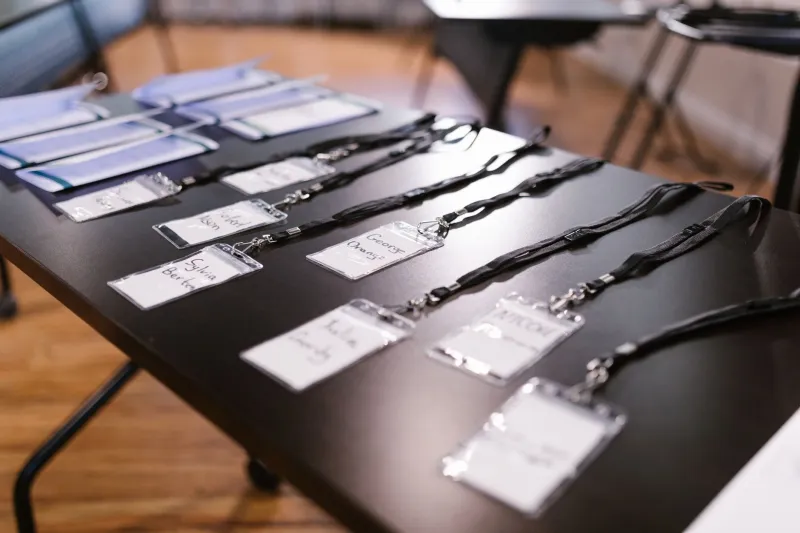
The badge hanging around your neck is no longer a badge. It is a sensor, a wallet, and — depending on which box you ticked at registration — a licensing agreement. Somewhere behind the registration desk, your name is being stitched to a session you entered for eight minutes, a coffee break you lingered at, a booth conversation you assumed was private, and a keynote you may or may not have actually watched.
None of this is inherently sinister. A measured floor is a better floor. Session heat maps tell program chairs which rooms are too small and which panels are coasting on reputation. Dwell-time data helps exhibitors stop wasting a senior buyer's afternoon. The problem is not measurement itself. The problem is asymmetry: the organizer knows what it collected, the exhibitor knows what it bought, and the person wearing the lanyard usually knows nothing.
The Floor Became a Spreadsheet
Consider what a typical large US congress captures in a single day. Badge scans at session doors establish attendance and timing. Beacons and, increasingly, ultra-wideband tags estimate movement and dwell. The event app logs favorites, searches, map queries, and whether the push notification was opened. Exhibitors run lead capture at the booth, sometimes with a qualification survey attached. Wi-Fi association data, where permitted, fills in the gaps.
Each individual data point is trivial. Aggregated, they form a behavioral profile detailed enough to grade a professional's interests, seniority, and buying intent across three days. Organizers have a respectable name for the output — engagement intelligence — and in fairness, much of it genuinely improves the product.
But attendees are rarely told what the aggregate looks like, and almost never told how long it lives or who else gets to see it.
The Consent Gap
The consent mechanism at most congresses is a terms-of-service checkbox administered at the moment of purchase, when the attendee is thinking about flights and hotel blocks. That is not meaningful consent by any serious standard. It is notice buried in a scroll.
There is a second gap, subtler and more consequential. Attendees generally assume a badge scan means a follow-up email from the company that scanned them. In practice, that scan may generate a scored lead record, flow into a data cooperative shared across a portfolio of events, or be appended to a third-party profile enriched with firmographic and intent signals. The attendee consented to a handshake. The record became an asset.
For executives, the stakes are not abstract. A senior vice president who spends an afternoon at a congress may effectively broadcast a research interest to competitors who buy the same syndicated audience segments. Sales organizations rarely think about that exposure. Legal departments should.
Fifty States, One Patchwork
The United States still has no comprehensive federal privacy statute, and the state layer has become the operative rulebook. California, Colorado, Connecticut, Virginia, Texas, Oregon, Montana, and a growing list of peers now impose contract terms, purpose limitation, consumer rights, and — in several cases — recognition of universal opt-out signals. Illinois remains a separate hazard for anything that touches biometric identification.
The practical consequence for event organizers is uncomfortable: the same badge scan carries different legal weight depending on where the attendee lives. Segmenting consent by residency is technically possible and operationally painful. Most organizers therefore default to the strictest applicable standard across the entire floor, which is the right instinct even when it costs them data volume.
Exhibitors, meanwhile, often inherit obligations they never negotiated. When a sponsor purchases a lead list, the sponsor typically becomes a controller or a business in its own right, with duties that do not transfer back to the organizer. The contract language governing that handoff deserves more scrutiny than it usually receives.
What Organizers and Exhibitors Owe the Badge
Three obligations seem defensible as a baseline, regardless of jurisdiction.
First, disclosure at the moment of collection. A visible, plain-language sign at each scanning point stating what is captured and who receives it. Not a link. A sign.
Second, a genuine opt-out. Attendees who decline tracking should be able to attend without being tracked, and the badge should signal that preference clearly. This requires the organizer to value a delegate's trust above a sponsor's list count.
Third, retention limits. Engagement data should have an expiration date disclosed in advance. Data that lives forever is data that eventually leaks.
Seven Questions to Ask Before You Register
Executives should treat the registration form the way they treat a vendor contract. Ask, in writing:
- What identifiers are collected, and does that include movement data from beacons or Wi-Fi?
- Who receives the raw scan record, and does it flow into any cooperative or shared audience pool?
- What is the retention period, and can I request deletion after the event?
- Is there a no-tracking option, and does declining affect my access to sessions?
- Can my lead records be enriched or appended by third parties without my further consent?
- Which states' privacy laws does the organizer apply to my record, and how is that determined?
- What does the exhibitor contract actually permit a sponsor to do with my contact data after the show?
Any organizer unable to answer these questions promptly is telling you something about their data governance that is worth knowing before you book the flight.
The Bottom Line
Surveillance gets a bad name because it is usually described by its critics. But the honest case for event analytics is strong: better programming, better floor design, better lead quality. The industry does not need to retreat from measurement.
It needs to stop pretending that measurement is invisible. A congress that tells attendees precisely what the lanyard is doing — and gives them a real way to say no — will not lose its audience. It will earn a reputation that no heat map can quantify, and sponsors will pay for proximity to that reputation long after the last beacon is switched off.